Oude-Reimer M, Binter J, Camba F, Ceccatelli M, Hankes-Drielsma I, Jørgensen E, Silva E
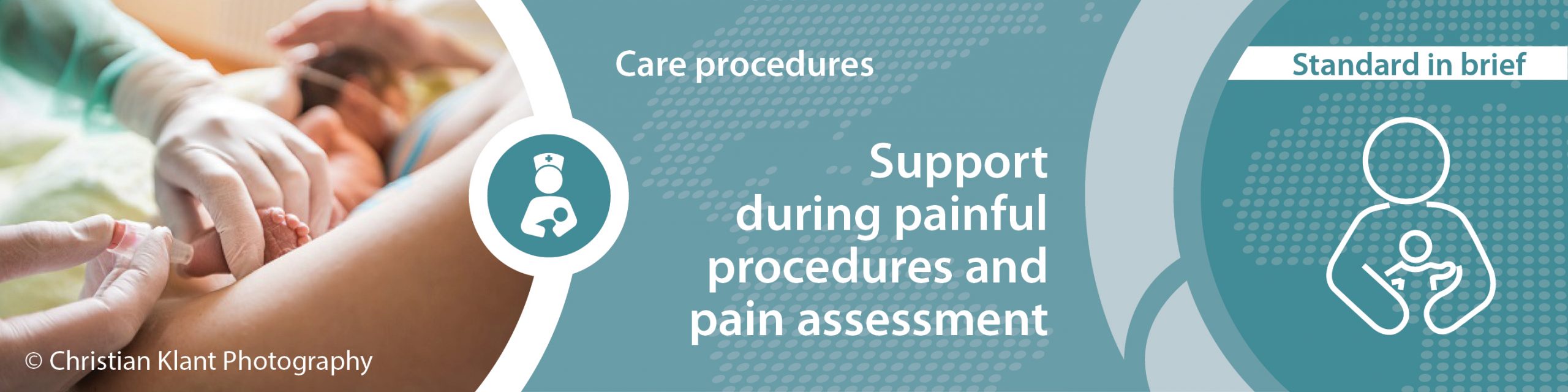
Click on the image to read the standard in brief.
Target group
Infants and parents
User group
Healthcare professionals, neonatal units, hospitals, and health services
Statement of standard
All infants in neonatal and paediatric units receive optimal comfort to minimise stress and pain, supported by their parents.
Rationale
Provision of optimal comfort, recognition, and treatment of pain are core skills underpinning all clinical care. Infants may be subjected to a large number of painful and stressful, although necessary, procedures during their care. Infants depend on others to recognise, to assess and to treat pain and discomfort. (1) The situation for the preterm infant is more complex than that of the full-term infant, since they often require intensive or high dependency care for many weeks, and their immature stage of neuromotor development may minimise the external manifestations of distress. Compared to older children preterm newborns have underdeveloped mechanisms that inhibit pain stimuli, are less able to communicate their pain and discomfort and are at greater risk for inadequate analgesia. Although awareness of symptoms of pain and stress is increasing, they are still often underestimated. (2)
Pain and stress may be minimised by regular expert prospective observation, respect for the infant’s behavioural cues of pain and discomfort, attention to positioning, the immediate environment and timing of intervention, and appropriate use of pain relief strategies, including non-pharmacological strategies (3)(e.g. presence parents 24/7, skin to skin care, breastfeeding, tuck, wrap, giving individualised supportive care and use of non-nutritive sucking) and analgesics. For some non-urgent procedures, empower the parents of the infant to stay at the NICU with their infant and apply with them the non-pharmacological pain relief procedures, programming the timing of the intervention. (4-7)
Benefits
Short-term benefits
Improved sleep (8)
Improved hormonal and physiological stability (9, 10)
Long-term benefits
Improved brain structure and development (11,12)
Improved behaviour (8,11,)
Components of the standard
Component
Grading of evidence
Indicator of meeting the standard
For parents and family
Parents should have the opportunity to stay with their infant 7/24.
A (High quality) B (High quality)
Audit report1, patient information sheet2
Parents are informed by healthcare professionals about strategies to optimise comfort, minimise painful stimuli and manage unavoidable pain during care (3,6,7)
A (High quality) B (High quality)
Patient information sheet2
Parents are informed by healthcare professionals about and offered the opportunity to be present and provide pain-alleviation during procedures (3,4)
A (High quality) B (High quality)
Audit report1, patient information sheet2
Parents are educated by healthcare professionals to recognise pain and discomfort signals in their infant and how to comfort the infant. (3)
A (High quality) B (High quality)
Patient information sheet2, training documentation
For healthcare professionals
A unit guideline on the importance of appropriate pharmacologic and non-pharmacologic pain relief strategies during care and procedures is adhered to by all healthcare professionals.
B (High quality)
Audit report1, guideline
Training to recognise pain and distress in term and preterm infants is attended by all responsible healthcare professionals. (13,14)
A (High quality) B (High quality)
Audit report1, training documentation
Training to avoid any non-essential painful and discomfort procedures is attended by all healthcare professionals. (13,14)
A (High quality) B (High quality)
Training documentation
Pain and stress are assessed using validated tools. (13,15-17)
A (High quality) B (High quality)
Assessment tools
All infants receive appropriate pharmacological and non-pharmacological pain relief. (1,6,7,13,14)
A (High quality) B (High quality)
Audit report1, guideline
For neonatal unit
A unit guideline for maintaining comfort, avoiding unnecessary pain and discomfort and use of appropriate pharmacological and non-pharmacological pain relief is available and regularly updated. (14)
A (High quality) B (High quality)
Guideline
Each unit recognises and utilises an individualised developmental care approach when reducing and avoiding pain and discomfort experiences during infants stay in the hospital. (18)
A (High quality) B (High quality)
Audit report1
For hospital
Training to recognise pain and distress in term and preterm infants and to avoid any non-essential painful and discomfort procedures is ensured. (14)
A (High quality) B (High quality)
Training documentation
For health service
N/A
1The indicator “audit report” can also be defined as a benchmarking report.
2The indicator “patient information sheet” is an example for written, detailed information, in which digital solutions are included, such as web-based systems, apps, brochures, information leaflets, and booklets.
Where to go
Further development
Grading of evidence
For parents and family
Psychological support is offered to parents to cope with a stressful experience of their infant’s pain. (14,19)
A (Moderate quality)
Parents should be able to stay with their infant at the unit 24/7. (2,4,6)
B (High quality)
For healthcare professionals
N/A
For neonatal unit
N/A
For hospital
N/A
For health service
Promote strategies to license new preparations of pharmacological agents to relieve pain in infants. (10,20)
A (Moderate quality)
Promote research into new approaches to pharmacological and non-pharmacological support during painful procedures in infants.
B (High quality)
Getting started
Initial steps
For parents and family
Parents are verbally informed by healthcare professionals about strategies to optimise comfort, minimise painful stimuli and manage unavoidable pain during care.
Planned procedures are verbally discussed with parents.
Parents are able to stay with their infant at the unit 24/7 and supported during planned procedures. (1,5,26)
For healthcare professionals
Attend training to recognise pain and distress and to avoid any non-essential painful and discomfort procedures in infants.
For neonatal unit
Develop and implement a unit guideline on pain assessment and treatment.
Develop information material on strategies to optimise comfort, minimise painful stimuli and manage unavoidable pain during care for parents.
Use a validated pain assessment tool and a flowchart.
For hospital
Support healthcare professionals to participate in training on pain management.
For health service
N/A
Pillai Riddell RR, Racine NM, Gennis HG, Turcotte K, Uman LS, Horton RE, et al. Non-pharmacological management of infant and young child procedural pain. Cochrane Database Syst Rev. 2015 Dec 2;(12):CD006275.
Anand KJS, Erikssoon M, Boyle EM, Avila-alvarez A, Andersen RD, Sarafidis K et al. Assessment of continuous pain in newborns admitted to NICU’s in 18 European countries. Acta Paediatr. 2017;106(8):1248-59
Johnston C, Campbell-Yeo M, Fernandes A, Inglis D, Streiner D, Zee R. Skin-to-skin care for procedural pain in neonates. In: The Cochrane Collaboration, editor. Cochrane Database of Systematic Reviews [Internet]. Chichester, UK: John Wiley & Sons, Ltd; 2014 [cited 2016 Jul 27]. Available from: http://doi.wiley.com/10.1002/14651858.CD008435.pub2
Ullsten A, Andreasson M, Eriksson M. State of the Art in Parent-Delivered Pain relieving interventions in Neonatal Care: A scoling review. Front Pediatr. 2021;9:651846
Skin-to-Skin contact. Johnston C, Campbell-Yeo M, Disher T, Benoit B, Fernandes A, Streiner D, et al. Skin-to-skin care for procedural pain in neonates. Cochrane Database Syst Rev. 2017;2(2):CD008435.
Breastfeeding. Harrison D, Reszel J, Bueno M, Sampson M, Shah VS, Taddio A, et al. Breastfeeding for procedural pain in infants beyond the neonatal period. Cochrane Database Syst Rev. 2016;10(10):CD011248.
Axelin A, Kirjavainen J, Salantera S, Lehtonen L. Effects of pain management on sleep iin preterm infants. Eur J Pain. 2010;14(7):752-8
Hall RW, Anand KJS. Short- and long-term Impact of Neonatal Pain and Stress: More than a Quchie. NeoReviews. 2005;6(2):e69-e75
Neubert A, Lukas K, Leis T, Dormann H, Brune K, Rascher W. Drug utilisation on a preterm and neonatal intensive care unit in Germany: a prospective, cohort-based analysis. Eur J Clin Pharmacol. 2010 Jan;66(1):87–95.
Melchior M, Kuhn P, Poisbeau P. The burden of early life stress on the nociceptive system development and pain responses. Eur J Neurosci. 2022;55 (9-10):2216-41
Duerden EG, Grunau RE, Chau V, Groenendaal F, Guo T, Chakravarty MM, et al. Association of early skin breaks and neonatal thalamic maturation: A modifiable risk? Neurology. 2020;95(24):e3420 -e7
Campbell-YeoM, Eriksson M, Benoit B. Assessment and management of pain in Preterm Infants: A practice Update. Children. 2022;9(2):244
Committee on F, Newborn, Section on A, Pain M. Prevention and management of procedural Pain in the Neonate: An update. Pediatrics. 2016;137(2):e20154271.
Stevens BJ, Gibbins S, Yamada J, Dionne K, Lee G, Johnston C, et al. The premature infant pain profile-revised (PIPP-R): initial validation and feasibility. Clin J Pain. 2014 Mar;30(3):238–43.
Holsti L, Grunau RE, Oberlander TF, Osiovich H. Is it painful or not? Discriminant validity of the Behavioral Indicators of Infant Pain (BIIP) scale. Clin J Pain. 2008 Jan;24(1):83–8.
Olsson E, Ahl H, Bengtsson K, Vejayaram DN, Norman E, Bruschettini M, et al. The use and reporting of neonatal pain scales: a systematic review of randomized trials. Pain. 2021;162(2):353-60.
Sizun J, Ansquer H, Browne J, Tordjman S, Morin JF. Developmental care decreases physiologic and behavioral pain xpression in preterm neonates. J Pain. 2002;3(6):446-50
Simons LE, Goubert L, Vervoort T, Borsook D. Circles of engagement: Childhood pain and parent brain. Neurosci Biobehav Rev. 2016;68:537–46.
Carbajal R, Eriksson M, Courtois E, Boyle E, Avila-Alvarez A, Andersen RD, et al. Sedation and analgesia practices in neonatal intensive care units (EUROPAIN): results from a prospective cohort study. Lancet Respir Med. 2015 Oct;3(10):796–812.
Second edition, July 2025.
Lifecycle
5 years/next revision: 2029
Recommended citation
GFCNI, Oude-Reimer M, Frauenfelder O et al., European Standards of Care for Newborn Health: Support during painful procedures and pain assessment. 2025.
Please enter your job description and origin country
You are currently viewing a placeholder content from Facebook. To access the actual content, click the button below. Please note that doing so will share data with third-party providers.
You are currently viewing a placeholder content from Instagram. To access the actual content, click the button below. Please note that doing so will share data with third-party providers.
You are currently viewing a placeholder content from X. To access the actual content, click the button below. Please note that doing so will share data with third-party providers.