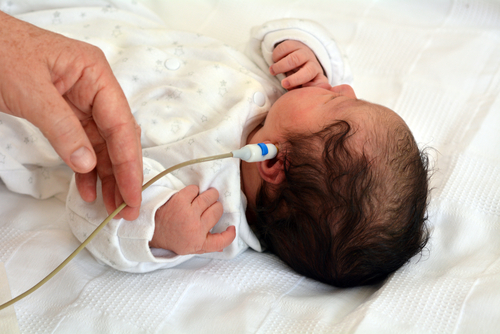
Infants born very preterm or those infants with risk factors including severe hyperbilirubinemia, positive family history, syndromes and craniofacial/ear abnormalities (see preamble Follow-up & continuing care) and parents
User group
Healthcare professionals, neonatal units, hospitals, follow-up teams, and health services
Statement of standard
Standardised hearing screening is conducted using Automated Auditory Brainstem Response (AABR) technology before discharge, with continuous tracking and ongoing surveillance of infants who fail the screening, to ensure that, where necessary diagnostic investigations are completed before three months and early interventions are started within the first six months.
Rationale
The goal of this standard is to ensure screening and evaluation of hearing function in high-risk newborn infants and start auditory habilitation and follow-up for those infants with diagnosed congenital or early hearing impairment. (1–4)
Permanent childhood hearing impairment (PCHI) has a prevalence of 1 per 1000 live-born children, rising to 6 per 1000 at school age and is usually defined as hearing impairment of 30 dB or more in the better ear. (4–5) Even this relatively limited hearing loss will impair language and speech development with lasting consequences. (6–8) Social and emotional development and academic achievements will also be affected. (9–13)
When the hearing impaired child is identified shortly after birth and appropriate interventions are started before 6 months of age, with family counselling and amplification with hearing aids or cochlear implants for the child, the gains are enormous. (6,7,10,13) Studies have shown that this can enable a child who is deaf or severely hard of hearing to achieve better outcomes in language and speech development, very often within the normal range, with ultimately much improved social, academic, and work achievements in adult life. (9,13–15)
Monitoring and follow-up, especially in the pre-lingual period, is essential, for all children with hearing loss and especially those with risk factors for progressive or late onset hearing impairment. (16)
Benefits
Short-term benefits
Early detection and management of hearing loss (1–4)
Long-term benefits
Early counselling to engage parents in their child’s special needs (16,17)
Early initiation of interventions (3,4,8)
Improved use of various means of communication (e.g. visual, tactile, and other stimuli) with a hearing impaired child from the earliest possible age (16)
Improved parent-child interaction and bonding (18)
Prevented or reduced language and speech developmental problems (7,17)
Prevented or reduced social and emotional problems (9,12)
Improved chances for attending mainstream education with better academic achievements (6,8,10), as well as optimal study and training opportunities with prospects for better work and financial potentials (11)
Reduced societal and educational costs (14–15)
Increased quality of life of children, parents and families (19,20)
Broader medical investigations which might not otherwise be initiated. Hearing impairment is often associated with other disorders and occurs frequently as part of a specific genetic syndrome (21)
Provides feedback for perinatal and public health records (consensus)
Components of the standard
Component
Grading of evidence
Indicator of meeting the standard
For parents and family
Parents are informed about universal neonatal hearing screening, and invited and encouraged by healthcare professionals to participate. (4,5)
A (High quality) B (High quality)
Patient information sheet1
Parents receive standardised feedback about the results of their child’s hearing screening in language that is accessible to them.
B (Moderate quality)
Parent feedback
Parents of children with a ‘failed’ hearing screening outcome are invited and encouraged by healthcare professionals to attend diagnostic assessments regarding cause, type and degree of hearing loss within three months of birth. (4–5)
A (High quality) B (High quality)
Clinical records, guideline, patient information sheet1
Parents of children with permanent childhood hearing impairment (PCHI) are invited and encouraged by healthcare professionals to begin interventions including family guidance and amplification for the child as early as possible after diagnosis, certainly within six months of birth. (4,17)
A (High quality) B (High quality)
Guideline, patient information sheet1
Parents have the opportunity to have contact with other parents of young children with hearing loss.
B (Moderate quality)
Patient information sheet1
Parents are asked for permission to allow their child’s medical and educational information to be used for outcome measures.
B (Low quality)
Parent consent, patient information sheet1
Parents are asked to consent to share the results of their child’s hearing screening tests with education providers.
B (Moderate quality)
Parent consent
For healthcare professionals
A guideline on hearing screening of all newborn infants using an appropriate validated objective screening method within one month of birth, or term equivalent age as well as gold standard audiological diagnostic investigations to evaluate the type and degree of hearing impairment when the hearing screening is not “passed” by the screening method is adhered to by all healthcare professionals. (4)
A (High quality) B (High quality)
Guideline
The screening method used is appropriate to the child and situation, e.g. very preterm infants are screened using AABR because of the risk of retrocochlear pathology. (3,4,22)
A (High quality)
Audit report2, guideline
Training on hearing screening and gold standard audiological diagnostic assessments used to evaluate the type and degree of hearing impairment when the hearing screening is not “passed”, is attended by all responsible healthcare professionals (screeners). (3,4,22)
A (High quality) B (High quality)
Training documentation
A guideline on diagnostic evaluation and early interventions to be started as early as possible after the diagnosis of hearing impairment and certainly before the age of 6 months, as well as on appropriate and adequate follow-up of children with hearing loss (including late-onset types) is adhered to by all healthcare professionals. (3,4,16)
A (High quality) B (High quality)
Guideline
For neonatal unit, hospital, and follow-up team
A guideline on hearing screening and referral for further interventions where necessary is available and regularly updated. (4)
B (High quality)
Guideline
Appropriate screening facilities and screeners are provided in hospitals where infants are born or admitted during the first weeks of life and also, when appropriate, in public health child services. (3-4)
A (High quality) B (High quality)
Audit report2
Training on hearing screening and gold standard audiological diagnostic assessments used to evaluate the type and degree of hearing impairment when the hearing screening is not “passed”, is ensured.
B (High quality)
Training documentation
For health service
A national guideline on universal neonatal hearing screening and referral for further interventions where necessary is available and regularly updated.
B (High quality)
Guideline
A national legal framework and funding is provided for hearing screening, diagnostic investigations, auditory habilitation, education, care, and follow-up. (3-4)
A (High quality) B (Moderate quality)
Legal framework
1The indicator ‘patient information sheet’ is an example for written, detailed information, in which digital solutions are included, such as web-based systems, apps, brochures, information leaflets, and booklets.
2The indicator ‘audit report” can also be defined as a benchmarking report.
Where to go
Further development
Grading of evidence
For parents and family
Ensure that parents who are deaf or severely hard of hearing themselves are sufficiently supported by a case manager and speech-to sign language interpreters and all other necessary communication methods.
B (High quality)
Provide funding to allow parents who are socially disadvantaged to participate in the follow-up hearing evaluations and interventions.
B (High quality)
For healthcare professionals
If required, provide sign interpreter.
B (Moderate quality)
For neonatal unit, hospital, and follow-up team
N/A
For health service
Evaluate and institute very early amplification. (23)
A (High quality)
Establish a statewide data management system for tracking and ongoing surveillance of infants who fail the screening.
A (High quality)
Getting started
Initial steps
For parents and family
Parents are informed about the availability of neonatal hearing screening facilities and the importance of attending, and when necessary, also attending for diagnostic investigations after a ‘failed’ screen result.
For healthcare professionals
Attend training on hearing screening and gold standard audiological diagnostic assessments used to evaluate the type and degree of hearing impairment when the hearing screening is not “passed”.
Promote awareness of the devastating effects of congenital and early childhood hearing impairment and the significant benefits of early detection and habilitation of hearing impairment.
Use any available tool to test hearing in a standard way for screening.
For neonatal unit, hospital, and follow-up team
Develop and implement a guideline on neonatal hearing screening.
Develop information material on neonatal hearing screening for parents.
Provide a service to perform standardised hearing screening.
Support healthcare professionals to participate in training on neonatal hearing screening.
Provide a service to perform standardised hearing screening.
For health service
Develop and implement a national guideline on universal neonatal hearing screening.
Work towards having facilities in place for those who fail the screening with adequate and appropriate diagnostic and habilitation facilities available for all.
Frezza S, Catenazzi P, Gallus R, Gallini F, Fioretti M, Anzivino R, et al. Hearing loss in very preterm infants: should we wait or treat? Acta Otorhinolaryngologica Italica. 2019 Aug;39:257-262. doi: 10.14639/0392-100X-2116
Zeitlin J, Maier RF, Cuttini M, Aden U, Boerch K, Gadzinowski J, et al. Cohort Profile: Effective Perinatal Intensive Care in Europe (EPICE) very preterm birth cohort. Int J Epidemiol. 2020;49(2): 372-386.
Kono Y. Neurodevelopmental outcomes of very low birth weight infants in the Neonatal Research Network of Japan: importance of neonatal intensive care unit graduate follow-up. Clin Exp Pediatr. 2021;64(7):313-321.
Joint Committee on Infant Hearing. Year 2019 position statement: Principles and guidelines for early hearing detection and intervention programs. J Early Hearing Detection & Intervention. 2019;4(2):1-44.
Butcher E, Dezateux C, Cortina-Borja M, Knowles, R. Prevalence of permanent childhood hearing impairment identified by universal newborn hearing screening: A systematic review and meta-analysis. Revue d’épidémiologie et de santé publique, 2018 Jul;66:S313. https://doi.org/10.1016/j.respe.2018.05.200
Ching TYC, Leigh G. Considering the impact of Universal Newborn Hearing Screening and early intervention on language outcomes for children with congenital hearing loss. Hearing Balance Commun. 2020;18(4):215-224.
Ching TYC, Dillon H, Button L, Button L, Seeto M, Van Buynder P, et al. Age at Intervention for Permanent hearing loss and 5-year language outcomes. Pediatrics. 2017 Sep;140(3):e20164274.
Fitzpatrick EM, Crawford L, Ni A, Durieux-Smith, A. A descriptive analysis of language and speech skills in 4- to 5-yr-old children with hearing loss. Ear Hear. 2011 Jan;32(5):605-616.
Michael R, Attias J, Raveh E. Cochlear implantation and social-emotional functioning of children with hearing loss. J Deaf Stud Deaf Ed. 2019;24(1):25-31.
Pimperton H, Blythe H, Kreppner J, Mahon M, Peacock JL, Stevenson J, et al. The impact of universal newborn hearing screening on long-term literacy outcomes: a prospective cohort study. Arch Dis Child. 2016 Jan;101(1):9–15.
Jørgensen AY, Engdahl B, Mehlum IS, Aarhus L. Weaker association between hearing loss and non-employment in recent generations: the HUNT cohort study. Int J Audiol. 2023;62(4):312-319.
Long GC, Umat C, Din NC. Socio-emotional development of children with cochlear implant: A systematic review. Malays J Med Sci. 2021 Oct;28(5):10–33.
Sarant JZ, Harris DC, Bennet LA. Academic outcomes for school-aged children with severe–profound hearing loss and early unilateral and bilateral cochlear implants. J Sp Lang Hear Res. 2015;58:1017-1032.
Cejas I, Barker DH, Petruzzello E, Sarangoulis CM, Quittner AL. Costs of severe to profound hearing loss & cost savings of cochlear implants. Laryngoscope. 2024; 00:1-8. https://doi.org/10.1002/lary.31497
Chorozoglou M, Mahon M, Pimperton H, Worsfold S, Kennedy CR. Societal costs of permanent childhood hearing loss at teen age: a cross-sectional cohort follow-up study of universal newborn hearing screening. BMJ Paediatrics Open. 2018; 2:e000228. https://doi:10.1136/bmjpo-2017-000228
Cupples L, Ching TYC, Button L, Leigh G, Marnane V, Whitfield J, et al. Language and speech outcomes of children with hearing loss and additional disabilities: identifying the variables that influence performance at five years of age. Int J Audiol. 2018;57:S93-S104.
Muñoz K. The hearing loss talk: Parents of newly identified children need more than unbiased information about options. they need empathy, empowerment, and perhaps most of all a major role in decision-making. ASHA leader. 2020 Mar;25(2):52-59.
Curtin M, Cruice M, Morgan G, Herman R. Assessing parent-child interaction with deaf and hard of hearing infants aged 0–3 years: An international multi-professional e-Delphi. PLoS ONE. 2024 Apr;19(4):e0301722.
Lindburg M, Ead B, Jeffe DB, Lieu JEC. Hearing loss–related issues affecting quality of life in preschool children. Otolaryngol Head Neck Surg. 2021;164(6):1322-1329.
Yigider AP, Yilmaz S, Ulusoy H, Kara T, Kufeciler L, Kaya KH. Emotional and behavioral problems in children and adolescents with hearing loss and their effects on quality of life. Int J Ped Otorhinolaryngol. 2020 Oct;137:110245.
Wener ER, McLennan JD, Papsin BC, Cushing SL, Stavropoulos DJ, Mendoza-Londono R, et al. Variants in Genes Associated with Hearing Loss in Children:Prevalence in a Large Canadian Cohort. Laryngoscope 2024;134:3832-3838.
Hood LJ. Auditory neuropathy/dys-synchrony disorder: Diagnosis and Management. Otolaryngol Clin N Am. 2015;48:1027–1040.
Kamenov K, Chadha S. Methodological quality of clinical guidelines for universal newborn hearing screening. Dev Med Child Neurol. 2020; 63:16-21.
Second edition, December 2024. Previous edition reviewed by Wróblewska-Seniuk K.
Lifecycle
5 years/next revision: 2029
Recommended citation
GFCNI, Kei J, Huening B et al., European Standards of Care for Newborn Health: Hearing screening. 2024.
Please enter your job description and origin country
You are currently viewing a placeholder content from Facebook. To access the actual content, click the button below. Please note that doing so will share data with third-party providers.
You are currently viewing a placeholder content from Instagram. To access the actual content, click the button below. Please note that doing so will share data with third-party providers.
You are currently viewing a placeholder content from X. To access the actual content, click the button below. Please note that doing so will share data with third-party providers.